Back to Exams
MicrosoftDP-420
Designing and Implementing Cloud-Native Applications Using Microsoft Azure Cosmos DB
This certification validates practical ability to design, deploy, and operate scalable cloud services, with emphasis on cloud architecture and operations. It is intended for professionals who manage reliable, secure, and cost-aware environments.
Rate this exam
Exam Details
Total Questions
213Last Updated
Aug. 2026Rating
4.9
Question Types
Multi choices
128Drag&Drop
10Hotspot
75 Get Full Access
Unlimited access to all questions
Detailed explanations for every question
Page progress: 3 / 437%
#11Hotspot
HOTSPOT -
You are creating a database in an Azure Cosmos DB Core (SQL) API account. The database will be used by an application that will provide users with the ability to share online posts. Users will also be able to submit comments on other users' posts.
You need to store the data shown in the following table.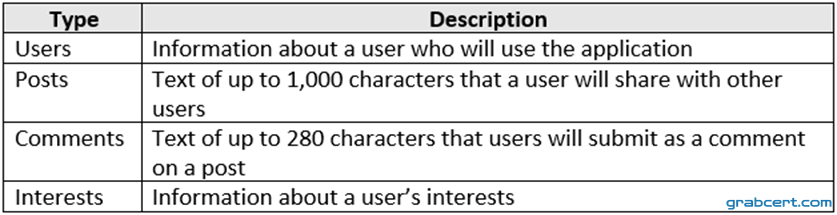
The application has the following characteristics:
✑ Users can submit an unlimited number of posts.
✑ The average number of posts submitted by a user will be more than 1,000.
✑ Posts can have an unlimited number of comments from different users.
✑ The average number of comments per post will be 100, but many posts will exceed 1,000 comments.
✑ Users will be limited to having a maximum of 20 interests.
For each of the following statements, select Yes if the statement is true. Otherwise, select No.
NOTE: Each correct selection is worth one point.
Hot Area: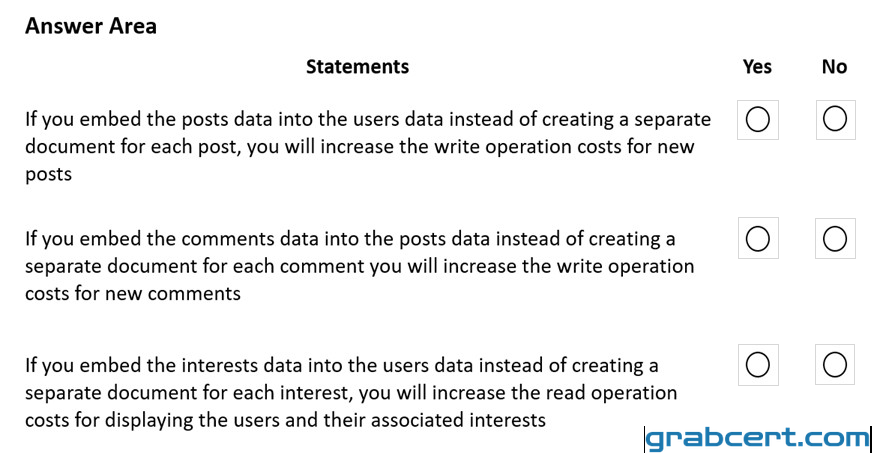
#12Drag & Drop
DRAG DROP -
You have an app that stores data in an Azure Cosmos DB Core (SQL) API account The app performs queries that return large result sets.
You need to return a complete result set to the app by using pagination. Each page of results must return 80 items.
Which three actions should you perform in sequence? To answer, move the appropriate actions from the list of actions to the answer area and arrange them in the correct order.
Select and Place: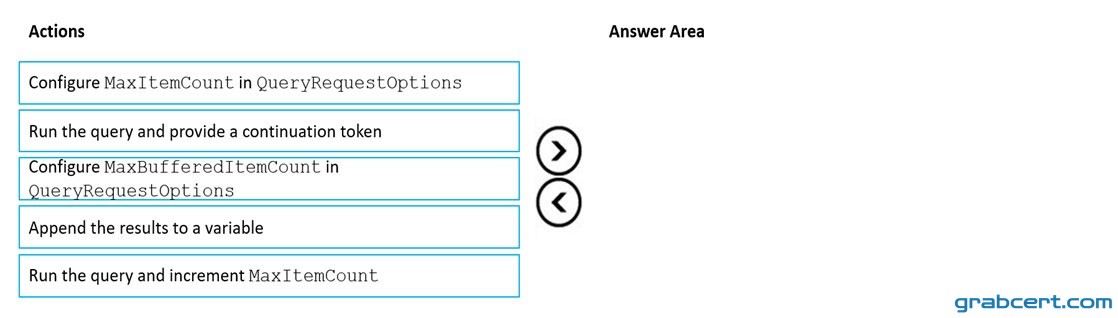
#13Multiple Choice
Note: This question is part of a series of questions that present the same scenario. Each question in the series contains a unique solution that might meet the stated goals. Some question sets might have more than one correct solution, while others might not have a correct solution.
After you answer a question in this section, you will NOT be able to return to it. As a result, these questions will not appear in the review screen.
You have an Azure Cosmos DB Core (SQL) API account named account 1 that uses autoscale throughput.
You need to run an Azure function when the normalized request units per second for a container in account1 exceeds a specific value.
Solution: You configure an Azure Monitor alert to trigger the function.
Does this meet the goal?
#14Multiple Choice
Note: This question is part of a series of questions that present the same scenario. Each question in the series contains a unique solution that might meet the stated goals. Some question sets might have more than one correct solution, while others might not have a correct solution.
After you answer a question in this section, you will NOT be able to return to it. As a result, these questions will not appear in the review screen.
You have an Azure Cosmos DB Core (SQL) API account named account 1 that uses autoscale throughput.
You need to run an Azure function when the normalized request units per second for a container in account1 exceeds a specific value.
Solution: You configure the function to have an Azure CosmosDB trigger.
Does this meet the goal?
#15Multiple Choice
Note: This question is part of a series of questions that present the same scenario. Each question in the series contains a unique solution that might meet the stated goals. Some question sets might have more than one correct solution, while others might not have a correct solution.
After you answer a question in this section, you will NOT be able to return to it. As a result, these questions will not appear in the review screen.
You have an Azure Cosmos DB Core (SQL) API account named account 1 that uses autoscale throughput.
You need to run an Azure function when the normalized request units per second for a container in account1 exceeds a specific value.
Solution: You configure an application to use the change feed processor to read the change feed and you configure the application to trigger the function.
Does this meet the goal?